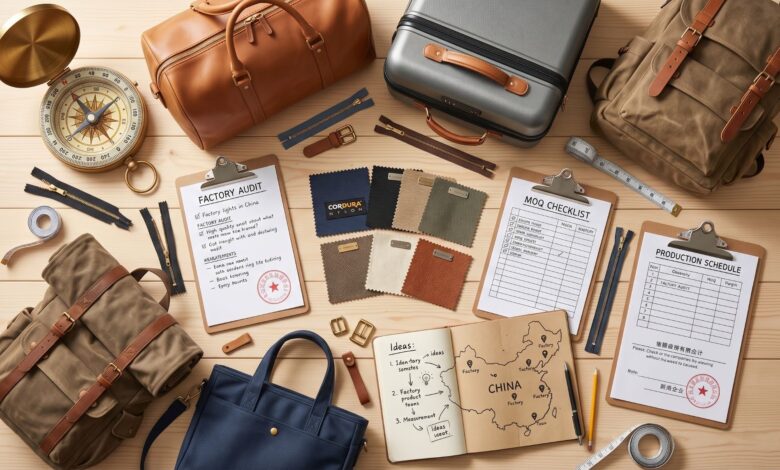
China is the primary manufacturing base for travel bags at every price point and category — from entry-level soft-sided bags to premium hard-shell luggage. For brands at any stage of development, understanding how to navigate the sourcing process efficiently is the difference between a product launch that goes to plan and one that does not.
This guide covers the four-step process experienced travel bag brand founders use when sourcing from Chinese manufacturers for the first time.
Step 1: Identify the Right Factory Type for Your Product
Before reaching out to suppliers, clarify what you are actually looking for: a factory that produces your specific product category, with in-house capability for your material requirements, at the MOQ threshold your order volume supports.
A travel bag manufacturer that handles both hard shell and soft bag styles under one roof reduces your supplier count and simplifies quality management. For brands with a multi-category product line, this consolidation matters: fewer supplier relationships, fewer QC frameworks to maintain, and typically better pricing on combined volume.
Request a factory profile before requesting a price. The profile should include: production categories, forming and assembly equipment, current production capacity, export markets, and references from existing clients in your target market.
Step 2: Request Samples and Verify Quality Against Specification
The sample is not a preview — it is a contract. Whatever deviations you accept at sample stage become the production standard for the bulk order. Test every functional element: structure, hardware, closure, surface finish, interior construction. Document approvals and rejections in writing with photographs.
For hard-shell products, request samples from existing tooling if available. New mold development extends the sampling timeline by 30 to 45 working days and adds tooling cost. For a first order with a new supplier, using existing tooling to validate quality before committing to tooling investment is the lower-risk approach.
Step 3: Confirm MOQ, Lead Time, and Payment Structure
Confirm three numbers before issuing a purchase order: MOQ (and whether it applies per color or per total order), bulk production lead time from deposit receipt, and payment terms.
Standard industry payment structure is 30% deposit against proforma invoice, with 70% payable against bill of lading. This protects both parties — the factory has working capital, the buyer has leverage before releasing full payment.
Step 4: Manage Export Logistics from Factory to Warehouse
Export logistics is the most frequently underestimated stage in the sourcing process. Ocean freight transit times, customs clearance, import duties, and last-mile delivery all add time and cost that do not appear in the factory’s lead time quote.
Work with a freight forwarder who has experience with your destination country’s import requirements. Budget for pre-shipment inspection — a third-party inspector at the factory before loading adds cost but significantly reduces the risk of receiving off-specification product.
Manufacturers like Aluvox support aluminum, PC, and travel bag OEM programs from a single Dongguan facility, with MOQ starting from 300 pieces and full private label capability — giving brand founders a single sourcing relationship that can cover a multi-category product launch.
READ ALSO: Pillow Packaging: Stylish and Functional Packaging Designs for Retail Products