Choosing an ABA center for your child with autism is one of the most important decisions you will make after receiving a diagnosis of autism. How your child develops communication skills and behaviors and reduces problem behaviors or learns new ways of dealing with them, can be greatly impacted by the quality of services that your child receives.
Evidence-based Treatment Approaches
The approach of your child’s ABA provider is typically the largest factor that can contribute to the quality of an ABA center. Look at the practices of potential centers and make sure they use evidence-based practices. Unfortunately, many programs use “proprietary methods” to treat children with autism and these practices have not been studied in scientific research. Find out how your child’s ABA provider teaches skills such as speaking, reading, writing, and social behavior. Look for practices that have been studied in research such as discrete trial training, natural environment teaching, and a functional assessment of behavior.
Each program tracks different behaviors on a daily basis and uses the information gathered from the data in order to intervene in ways to increase the child’s learning. In order to find out more about a program’s data collection practices, it is very important to ask specific questions such as: How do you measure progress? What kind of data is collected on a daily basis and how is it used? A program can promise that children are learning, but if a program cannot give you specifics on how they measure progress then it is likely that their intervention practices are not as effective as others.
Staff Qualifications Matter More Than You Think
The BCBAs in the program are the ones that provide direct treatment to the children in the program and oversee cases of their own. As a result, it is very important to ask a program what the ratio is of BCBAs to children in the program. Typically, a program that has a higher ratio of BCBAs to children (i.e. 1:15 or less) will have more individualized programs for each of the children in the program and will be able to make the best decisions for each of the children in the program.
With the many qualified professionals working in the field of ABA, it is also very important to know that even with the proper certifications and training, that there are some better qualified than others to care for your child. It is always best to ask a center about the ongoing training of its staff. This includes the RBTs and every other staff member. The center should have a number of different training programs going on at all times to continue to ensure that every child in their care is receiving the best possible care.
The rate of staff turnover- why did they leave the program and how long did it take to fill the position. With children with Autism and other special needs it is very important to have consistent therapy, if a therapist were to leave a program in which your child is receiving treatment there would be a period of time where your child would not be receiving the best treatment until a new replacement could be found, trained and became comfortable with your child.
Family Involvement Programs
Most children with autism are in therapy within the walls of a center. In contrast, children with autism and their families benefit from programs that actively involve parents and caregivers in the child’s treatment. Such programs help the child learn to increase his or her potential for success in the natural environments in which he or she lives. This is why it is so important for a center to provide specific guidance on managing behaviors during daily routines for example. Some centers even have programs for the siblings of children with autism. Such programs teach the siblings of children with autism how to support their brother or sister in therapeutic activities and how to cope with the emotional challenges of having a sibling with autism. Quality programs include parents and caregivers in the treatment of the child with autism. These programs teach parents and caregivers how to implement strategies in the natural environments in which their child lives.
A child receiving ABA at a center should be learning skills throughout the day in all of the routines that the child and his or her family go through. In order to do this, the center should be teaching the child and his or her family how to handle the child’s behaviors that occur in daily routines, such as tantrums, when the child does not get his or her way. It is also very helpful to a family to know that the center offers a program for the siblings of children of children receiving ABA in order to help the siblings of children with autism as well.
When searching for ABA programs for your child with autism you may want to research programs similar to a New Jersey ABA center, that have very effective clinical programs as well as great support for families.
Treatment Individualization
No two children with autism are exactly alike. Each child has their own strengths, challenges, and ways of learning. A good ABA program provides individualized approaches to teaching new skills. The program treatment is based on a child’s individual needs, and the approach is changed as the child learns new skills. The type of teaching used by a child’s therapist can vary.
The best ABA center for your child will have established treatment goals for each individual before they even enroll at the center. These goals would have been established by a thorough assessment of the individual’s current level of functioning with regards to their communication skills, social skills, adaptive behaviors, and academic readiness, etc. The center should be able to explain how they established the treatment goals for each individual and how the goals will be regularly updated to ensure that the most effective treatment is being provided to your child.
A good ABA program for children with autism will have specific goals for that child’s progress. Those goals will be based on the data collected from the child’s assessment and regularly updated based on that child’s progress. There are also many different ways to teach skills to children with autism, and a good ABA program will teach in a way that is most appropriate for that child’s learning style. For example, a program may teach in a highly structured classroom setting using discrete trials to teach a variety of skills, or they may teach in a child’s natural environment using a naturalistic teaching approach and a variety of teaching methods to best meet that child’s individual needs.
Environment and Safety Protocols
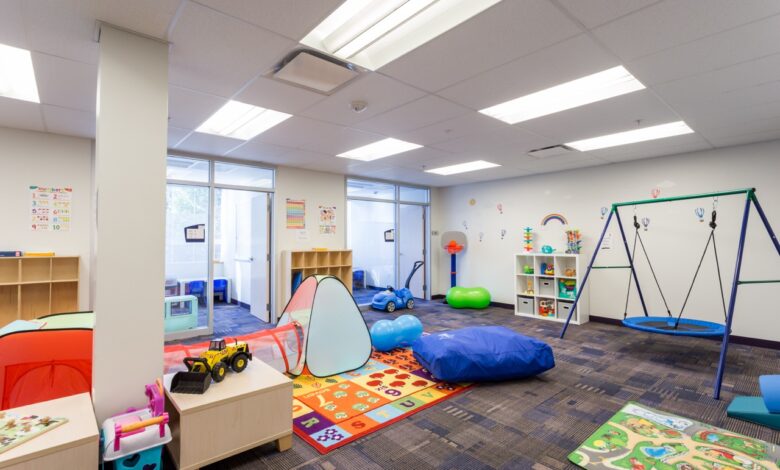
1) How are the Treatment Rooms Set Up? Is there material relevant to the child and is the room distraction free? Does the child have safety protocols in place to manage self-injurious behaviors and elopement? This will give you an idea of how a child’s treatment room is set up and how a staff member treats a child. If a child is calm in a room with a therapist then the center must be running a calm and structured environment. If a child appears to be bored or even be overwhelmed in a session then this is not the center for your child.
So go look at some centers. When you walk into a room where kids with autism are being treated with ABA, there are a few things that you should see. The kids should look happy, engaged and perhaps even happy to be there (yes, this does happen). The staff should be calm and be speaking in a very clear and very structured speech. They should be actively engaged with the kids in some activity that looks to be fun but also to be therapeutic in some way. The kids should not appear to be over-whelmed and they should not appear to be bored.
Making the Decision
Be wary of a program that only extols the praises of a program based off the testimonials of happy families. Do your research on many ABA programs. Also ask for referrals of current families and ask them for a tour of the program. Ask the family how did the center handle situations where there were conflicts with family members. How long did it take for their child to start to make gains? An honest tour by a family who is currently going through ABA at a program can be worth so much more than a website that touts how wonderful a program and staff are.
A quality ABA center is transparent. They should welcome the opportunity to have their practices scrutinized by a prospective family. They should be able to articulate their practices and report their data on a child’s progress to a family. Informed parents are generally better therapeutic partners for their children than parents who make a decision based on incomplete information.
Choosing the right ABA center for your child is an important decision for his or her short- and long-term development. By taking the time to go through an evaluation of ABA programs in your area, applying the above steps in a methodical manner to evaluate the quality of each ABA center’s methods and practices, the evaluation process can be productive rather than overwhelming.