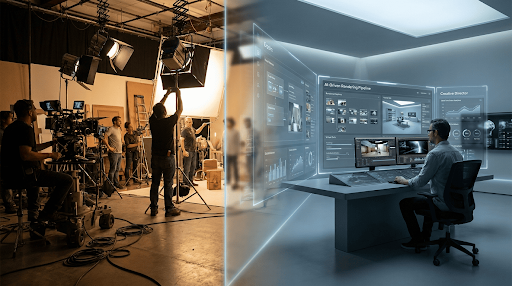
Three years ago, a high-quality video ad campaign followed a predictable, slow, and expensive path. You started with a creative brief, moved to a week of storyboarding, and then spent thousands on a production crew. If you wanted to test ten different variations of a hook, you had to film those ten variations on set. Today, that entire model has been dismantled.
The industry is currently facing a massive content fatigue crisis. Modern consumers scroll past traditional commercials in milliseconds. To capture attention, brands now need a constant stream of fresh, relevant, and hyper-personalized content. The speed of digital marketing has simply outpaced the slow machinery of traditional production.
Performance marketers and brand managers no longer have the luxury of waiting weeks for a single asset. The demand for high-volume output without sacrificing aesthetic quality has created a massive gap in the market. This is where the next generation of creative technology enters the picture.
The Content Fatigue Crisis
In the current social media landscape, the lifespan of a video ad is shorter than ever. An ad that performs well on Monday might see its engagement drop by Friday. This phenomenon, known as creative fatigue, happens when an audience sees the same visual assets too many times.
To combat this, brands have historically tried to produce “more.” However, “more” usually meant lower quality. We saw a rise in “raw” content that looked cheap or rushed. While authenticity is important, brands still need polished, cinematic commercials to maintain their premium positioning.
The challenge is scaling the unscalable. How do you produce fifty unique, high-fidelity video ads in the time it used to take to produce one? The answer lies in the evolution of marketing automation and the rise of intelligent creative engines.
The Problem with Traditional Production Cycles
- High upfront costs for equipment, talent, and locations.
- Rigid timelines that do not allow for real-time pivots.
- Limited ability to personalize content for specific niche audiences.
- The “all-or-nothing” risk of a single big-budget production.
The Dawn of Intelligent Creative Engines
The biggest shift in the last three years is the move from basic video editors to intelligent engines. We are no longer just cutting clips together. We are using state-of-the-art AI models to generate entire scenes from scratch. This shift is highlighted by research from McKinsey on the economic potential of generative AI, which notes that marketing is one of the sectors most impacted by this technology.
One of the most significant breakthroughs in this space is the Seedance 2.0 model. Developed by ByteDance, this model represents a massive leap forward in video generation technology. It allows creators to move beyond simple text-to-video prompts and into complex, multi-modal workflows.
In the past, AI video often looked shaky or lacked character consistency. If a character appeared in shot one, they might look like a different person in shot two. Seedance 2.0 solves this by maintaining frame-level precision and character consistency across cinematic multi-shot sequences.
Seedance 2.0: The New Gold Standard
This model is not just a tool for fun. It is a professional-grade engine designed for high-stakes advertising. Here is what makes it a game-changer:
- Multi-Asset Inputs: It accepts up to 12 different assets including text, images, videos, and audio.
- Native Audio Sync: It ensures that lip movements and actions match the audio track perfectly.
- Cinematic Quality: It produces high-fidelity visuals that rival traditional film sets.
- Precision Control: Creators can guide the AI with specific image references to ensure brand alignment.
Professional platforms like higgsfield provide direct access to Seedance 2.0 across all subscription plans. This democratizes high-end production, allowing small teams to compete with global agencies in terms of visual output.
Strategies for a New Era of Ad Production
Adapting to this new landscape requires more than just new software. It requires a shift in how we think about the creative process. Instead of focusing on a single “hero” video, marketers must focus on building a creative system.
By using marketing automation for the creative side of the funnel, you can experiment with different narratives simultaneously. You can run an unboxing video, a tutorial, and a CGI-heavy spot all at once to see which one resonates with your specific audience segments.
Leveraging Multi-Asset Inputs for Precision
To get the most out of AI video generation, you should provide the model with as much context as possible. Seedance 2.0 allows you to upload product photos or existing video clips to serve as a foundation. This ensures the AI understands the physical properties of your product before it starts generating.
- Upload high-resolution product images to maintain visual accuracy.
- Provide a clear script or audio file to guide the pacing of the video.
- Use reference videos to define the desired camera movement or lighting style.
- Iterate on the “hook” of the video while keeping the core product demonstration the same.
Hyper-Personalization at Scale
The future of ad production is defined by the ability to create infinite variations. Imagine being able to swap the background, the actor, and the language of an ad with a few clicks. This level of marketing automation allows brands to speak directly to different demographics without the cost of multiple film shoots.
A brand can now deploy 40+ AI avatars to represent various personas. This ensures that every viewer feels represented. Whether you need a virtual try-on for e-commerce or a product demo video for a B2B service, the ability to generate these assets from a simple URL is a massive strategic advantage.
Integrating AI into Your Creative Stack
For many brands, the barrier to entry for AI video was the technical setup. Early models required complex coding or expensive hardware. Today, the focus has shifted toward zero-setup workflows.
A modern creative stack should act as an in-house production studio that never sleeps. It should bridge the gap between the speed of digital marketing and the traditionally slow pace of video production. This is the core philosophy behind higgsfield, which positions itself as the creative half of the modern marketing stack.
The Hermes Agent Advantage
The introduction of intelligent agents like the Hermes Agent has simplified the creative process. Instead of wrestling with complex prompts, users can interact with an agent that understands marketing goals. This agent can take a product link and automatically generate a full suite of diverse ad formats.
- Transform a single URL into a cinematic commercial.
- Generate “raw” iPhone-style UGC for social proof.
- Create 9 different ad formats optimized for various platforms like TikTok, Instagram, and YouTube.
- Automate the most human-intensive parts of the funnel: ideation and execution.
Automating from URL to Asset
One of the most powerful applications of marketing automation today is the ability to generate content directly from a product link. By analyzing the data on a webpage, platforms like higgsfield can identify key selling points and visual styles.
This creates a seamless bridge between your store and your ad account. When a new product launches, the creative assets can be generated, iterated upon, and deployed almost instantly. This level of efficiency was unimaginable only three years ago.
The Future of the Creative Role
As we lean more into marketing automation, the role of the creative professional is changing. It is moving away from manual labor—such as setting up lights or editing frames—and moving toward creative direction and strategy.
In this new era, the most successful marketers will be those who can harness these tools to tell better stories. They will use higgsfield to handle the heavy lifting of production while they focus on the high-level strategy of brand building.
The future of ad production is not about replacing humans. It is about empowering them to produce at the speed of their own ideas. By using higgsfield and its underlying Seedance 2.0 technology, brands can finally achieve the dream of “scaling the unscalable.”
The tools are here, and the workflows are ready. The only question is how quickly your brand can adapt to a world where production takes minutes, not weeks. As marketing automation continues to evolve, the competitive gap between those who embrace AI and those who resist it will only continue to grow.
In conclusion, the shift we have seen over the last three years is just the beginning. With the ability to create high-fidelity, cinematic video from simple inputs, we are entering a golden age of creative expression. By integrating higgsfield into your workflow, you ensure that your brand stays ahead of the curve in an increasingly fast-paced digital world.